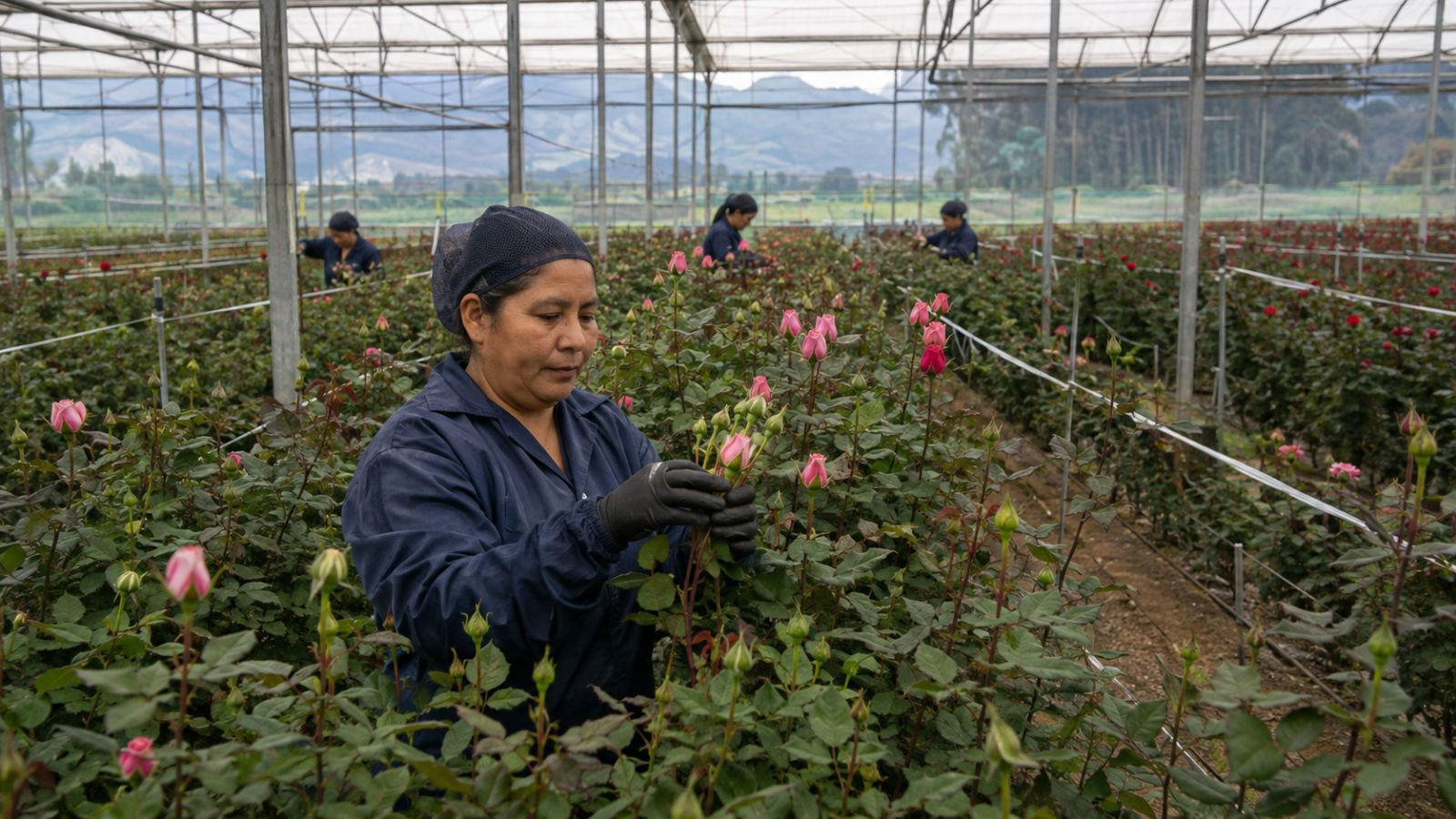
10 Leading Flower Farms in Colombia
The flower business has one appealing illusion: that altitude, cool nights, and intense equatorial sunlight determine everything. Colombia has indeed been given nearly ideal natural conditions. But between a good flower in the greenhouse and a reliable shipment reaching an importer lies a far more complex chain: breeding, grading and postharvest handling, an uninterrupted cold chain, packaging, certification, and logistics where every hour matters.
This is where the difference between a large flower farm and a world-class producer becomes apparent.
Colombia is home to very different businesses operating side by side: large groups supplying North American retail chains, family-owned companies growing garden roses for the cut flower market, chrysanthemum specialists, and producers that have developed ocean freight programs for fresh cut flowers. Comparing them by hectares alone is much like comparing a fashion house with a textile mill based on the size of their buildings. Scale matters, but it says little without knowing what a company grows, who it supplies, in what volumes, and how openly it reports on its operations.
There is no publicly available official ranking of Colombian flower farms by revenue or production volume. This list therefore brings together companies whose market position can be assessed through published data, including production area, assortment, sales geography, certifications, technology, and industry recognition. Where a figure applies to an entire international group rather than specifically to its Colombian farms, that distinction is noted in the text.
Colombia in the Global Flower Market
In 2025, Colombia exported more than 338,000 metric tons of flowers worth $2.376 billion. The country remains the world's second-largest flower exporter. This position is not simply the result of a favorable climate. Behind the figures is a mature production system built around international markets.
The country's main floriculture region is the Bogotá Savanna. This high-altitude plateau in Cundinamarca has become the principal center for large flower farms growing roses, carnations, and alstroemeria. A second major production cluster has developed in Eastern Antioquia near Medellín. The region is particularly strong in chrysanthemums, including pompon types, and other crops well suited to local growing conditions and export logistics.
Consistent day length, intense light, and cool nights help produce long stems, firm buds, and strong color. But today's buyer is not purchasing climate. The buyer is purchasing predictability: consistent grading from week to week, dependable availability, controlled temperatures, appropriate packaging, and a supplier that remains responsive after the invoice has been issued.
Environmental and social standards are covering an increasing share of Colombian floriculture. According to Asocolflores, the area certified under the Florverde Sustainable Flowers standard increased from 6,300 ha in 2024 to 9,400 ha in 2025.
How This Top 10 Was Compiled
The largest flower farm does not necessarily offer the most interesting assortment, and a specialist producer of rare cut garden roses does not need to compete with an international group on acreage. The companies were therefore assessed across several dimensions rather than a single metric. Production scale, export reach, specialization, certification, technology, logistics, and professional reputation were all considered.
The article compares companies and the Colombian farms they operate rather than individual greenhouses. Where producers disclose sufficient data, total farm area, greenhouse area, and own production volumes are presented separately. For international groups, some figures apply to the entire business, and this is explicitly stated in the relevant company profile.
Some well-known companies publish very few figures. That does not make them weaker businesses, but it does make direct comparison difficult when other producers openly disclose farm area, production volumes, and operating structure.
At a Glance
| Rank | Company | Main Specialization | Confirmed Scale | Key Distinction |
| 1 | Sunshine Bouquet | Roses, broad flower assortment, finished bouquets | More than 2,500 acres of land in Colombia, including approximately 313 ha of rose farms | Largest publicly disclosed production footprint in Colombia |
| 2 | The Elite Flower | Roses and more than 75 product categories | Nearly 2,000 ha and 2.7 billion stems annually across the international group | Largest international group on the list |
| 3 | Jardines de los Andes | Alstroemeria, chrysanthemums, and other crops | More than 200 ha and 311 cultivars | Scale, diversity, and measurable environmental performance |
| 4 | Flores El Capiro | Chrysanthemums, including pompon types | 154 ha and 296 million stems annually | Ocean freight, B Corp status, and a strong technology base |
| 5 | Flores de Funza | Roses, alstroemeria, carnations | More than 200 ha of production area | More than 25 destination countries and documented automation |
| 6 | Falcon Farms | Roses and finished supply programs for retail chains | Area not disclosed; operates a network of farms in Colombia and Ecuador | Vertical integration, hydroponics, and U.S. infrastructure |
| 7 | Flores Silvestres | Chrysanthemums, gerberas, asters, and other crops | Nearly 85 million stems annually | Current production figures and a modern production base in Antioquia |
| 8 | Alexandra Farms | Premium cut garden roses | Approximately 20.2 ha and more than 42,000 stems per day | One of the world's leading producers of cut garden roses |
| 9 | Redil Roses | Standard and spray roses | 36 ha across five production sites | Focused rose specialization and a clearly defined production structure |
| 10 | Grupo Andes Farms | Roses and alstroemeria | More than 50 ha across two farms | More than 60 rose cultivars and over 50 years of export experience |
1. Sunshine Bouquet
Largest Confirmed Acreage in Colombia
Sunshine Bouquet provides unusually detailed information about the Colombian side of its business. In an industry where international groups often combine acreage from several countries into a single impressive figure, that degree of specificity is relatively uncommon.
Sunshine's history began in the United States in 1971. Its Bogotá operation opened in 1995, and in 2002 the company began acquiring its own farms in Colombia. Today it reports more than 2,500 acres of land on the Bogotá Savanna, approximately 1,012 ha. It separately identifies 20 rose farms covering a combined area of about 313 ha. The company does not disclose the exact greenhouse area.
The rose catalog includes more than 200 cultivars, among them Pink Floyd, Deep Purple, Cool Water, Quicksand, Vendela, Glacier, and Pink Mondial. Across its broader portfolio, Sunshine offers more than 55 flower types and 800 cultivars. Its business is not limited to the wholesale floral trade. The company can supply year-round programs for major retail chains and assemble finished bouquets.
More than 900 million stems move through Sunshine's North American distribution network each year. This is the volume handled by the overall supply system, not a stated figure for the company's own production on its Colombian farms.
According to the company, all production sites are Rainforest Alliance certified. Its listed practices include rainwater harvesting, composting, waste recycling, biological control, and the use of safer refrigerants. Sunshine also exhibited at Proflora 2025.
Sunshine's scale is not measured only in hectares. The group controls the chain from flower production and bouquet assembly through delivery to North American retail chains. For a large buyer, that integration can matter more than a record number of cultivars.
2. The Elite Flower
An International Group with Colombian Roots
The Elite Flower began growing roses in Colombia in 1991 and later developed a network of farms in Colombia, Ecuador, and Kenya. By the scale of the international group as a whole, it is one of the largest businesses on this list.
The published figures reflect the scale of the international group: nearly 2,000 ha of production area, 2.7 billion stems annually, more than 1,000 flower cultivars, and 75 product categories. These figures apply to the group as a whole. The company does not publish separate metrics for its Colombian farms.
Its rose catalog includes Freedom, Esperance, Glacier, Deep Purple, Cool Water, Pink O'Hara, and Playa Blanca. But defining Elite primarily through roses would miss its main strength. The business is built around the ability to run year-round supply programs for supermarkets, assemble bouquets, and work across a large number of product categories at the same time.
The corporate website lists Florverde Sustainable Flowers, GLOBALG.A.P., Rainforest Alliance, BASC, Fair Trade USA, and the industry-specific OHAS scheme, the Ornamental Horticulture Assurance Scheme. The group also participated in Proflora 2025.
Elite's scale has another side. The larger the group, the more impressive its consolidated figures become, and the more carefully a buyer needs to determine which portion of those figures applies to a particular country and production site.
3. Jardines de los Andes
Diversified Production Since 1969
Jardines de los Andes has operated since 1969 and is among Colombia's oldest active flower producers. Today, however, the company is notable not simply for its history or for any one crop. Its principal strength is the breadth of its assortment.
Jardines reports more than 200 ha, over 40 product categories, and 311 cultivars. Its catalog separately lists 46 alstroemeria cultivars and 81 pompon chrysanthemum cultivars. Jardines is now a large diversified producer of cut flowers rather than a rose-dominant farm.
The company reports supplying more than 300 million flowers to buyers in the United States and Europe, although it does not specify the period covered by that figure.
Its environmental metrics are more specific. More than 75% of the water used comes from harvested rainwater. More than 20,000 metric tons of plant waste are converted into approximately 3,000 metric tons of compost. The website lists Rainforest Alliance, Florverde Sustainable Flowers, and participation in Sedex. Jardines also exhibited at Proflora 2025.
Jardines illustrates an important feature of the Colombian flower industry. One of the country's leading producers may be recognized not for a record-size rose catalog, but for its ability to grow a broad range of crops at commercial scale.
4. Flores El Capiro
Chrysanthemums and Ocean Freight
Flores El Capiro specializes in chrysanthemums rather than roses and is regarded as one of the most prominent pompon chrysanthemum producers in Eastern Antioquia.
The company's history began in 1982 under the name Geranios. In 1985, the business started growing roses, carnations, and chrysanthemums, and the name Flores El Capiro was adopted in 1997. Today, the producer operates eight sites, primarily in the municipalities of La Ceja and Rionegro, and reports 154 ha devoted to flower production and 296 million stems annually. Its assortment includes more than 80 chrysanthemum cultivars.
Capiro has also developed shipment programs using refrigerated ocean containers. For large chrysanthemum volumes and long-distance destinations, this approach can substantially reduce logistics costs. Production technologies include LED supplemental lighting, integrated pest management, in-house laboratories, and biological products based on beneficial fungi.
Capiro publishes one of the most comprehensive lists of certifications, audits, and industry credentials in this top 10. The company lists Florverde Sustainable Flowers, GLOBALG.A.P., Carbon Neutral, Sedex participation, SMETA auditing, the GRASP social module, and Authorized Economic Operator status. B Lab confirms that Flores El Capiro has been a certified B Corp since June 2024. Its B Impact Assessment score is 81.7. The company has also received recognition from AIPH and Asocolflores and participated in Proflora 2025.
In terms of data transparency, Capiro is a useful benchmark for the industry. It publishes acreage, production volume, assortment information, and details on technology, logistics, and standards. That combination remains uncommon even among large producers.
5. Flores de Funza
Two Hundred Hectares and Automated Grading
Founded in 1976, Flores de Funza has long ranked among the larger diversified producers on the Bogotá Savanna. The company reports more than 200 ha of production area and sales to more than 25 countries across Europe, North and South America, Asia, and the Middle East. Neither the exact greenhouse area nor annual stem volume is published separately.
The company offers more than 30 product types year-round. Its main categories include roses, alstroemeria, standard carnations, and spray carnations. Rose cultivars include Freedom, Deep Purple, Pink Floyd, Glacier, Momentum, Orange Crush, and Super Sun.
Funza's technology base is documented not only by the company itself. Equipment manufacturer Bercomex describes seven of its production sites and automated flower-processing lines. A Flora Bunchmaster line installed in 2020 allows grading and productivity to be monitored in real time. At this scale, automation addresses a practical challenge: maintaining consistent grading specifications across high production volumes.
Among the environmental standards shown on the Flores de Funza corporate website is Rainforest Alliance. The site also displays the SGS mark, but does not identify the specific standard under which an assessment was conducted. The company participated in Proflora in 2025.
More than 200 ha, sales to dozens of countries, a diversified catalog, and documented automation make Flores de Funza one of the most balanced businesses on the list. It does not rely on one headline figure that overshadows everything else. Instead, its strength lies in a production system whose different elements work together.
6. Falcon Farms
Colombian Farms and U.S. Infrastructure
Falcon Farms began operations in 1987 as a distributor. By 1989, it had established its first company-owned flower farm in Colombia. Today, the group also operates six facilities in the United States. Having its own infrastructure in its primary destination market allows Falcon to control not only production but also the subsequent movement of its flowers through the supply chain.
Falcon's geography shows why the phrase "Colombian growing conditions" is too broad to be particularly useful. Farms in Madrid, Tocancipá, and Suesca are located at elevations of approximately 2,550 to 2,570 m. The La Virginia farm in La Ceja is lower, at around 2,140 m. These differences affect microclimate and the specialization of individual production sites within the group.
The Colombian farms primarily grow roses. At La Niña de Mis Ojos in Tocancipá, 21 cultivars are grown hydroponically. The group's catalog includes Freedom, Glacier, Vendela, Deep Purple, Cool Water, and Orange Crush. Total acreage and current production volume are not disclosed, while different sections of the corporate website refer to 12 and 13 sites across Colombia and Ecuador.
The website lists Rainforest Alliance and Florverde Sustainable Flowers environmental standards, as well as the BASC and C-TPAT supply-chain security programs. The company reports producing 450 metric tons of compost annually and using beneficial insects and solar panels. By 2030, Falcon intends to reduce emissions per hectare by 5%. Certificate numbers and validity periods are not provided on the website.
Falcon's principal strengths are vertical integration, hydroponic production, and its U.S. infrastructure. At the same time, the group publishes considerably less information on acreage and production volumes than some of the market's largest participants.
7. Flores Silvestres
Diversified Production in Eastern Antioquia
Flores Silvestres demonstrates the diversity of Colombian floriculture. The company has operated since 1988, develops production sites in El Cármen and La Ceja, and does not specialize in roses.
Silvestres reports annual production of nearly 85 million stems and employs more than 1,100 people. The combined area of all farms is not stated. At the El Cármen site, premium pompon chrysanthemums occupy 15 ha, while gerberas are grown on another 1 ha.
The catalog includes chrysanthemums, snapdragons, gerberas, asters, decorative foliage, campanula, lepidium, dianthus, marigolds, and finished bouquets. The La Ceja site is oriented toward the United States and Canada, while the group also reports shipments to other countries.
The website lists GLOBALG.A.P., Rainforest Alliance, Sedex participation, and SMETA auditing. Its production base includes an automated gerbera greenhouse, a propagation area for planting material, a bouquet assembly facility, a flower-dyeing area, and a biological crop-protection laboratory. The company participated in Proflora 2025.
Today, Silvestres' scale is best illustrated by its annual production of nearly 85 million stems and more than 1,100 jobs. Behind those numbers is a mature Antioquia producer capable of working both with individual flower crops and finished bouquets.
8. Alexandra Farms
Cut Garden Roses
Compared with the industry's largest groups, Alexandra Farms operates on a more focused scale. The family-owned company, founded in 2005, holds a distinctive position in the international floral trade through its specialization in premium garden roses grown for cut flower production.
Its two principal sites, San Ignacio in Tocancipá and El Jardín in Gachancipá, cover approximately 50 acres, or 20.2 ha. Corporate materials describe this figure both as greenhouse area and as total production area, so the precise relationship between the two is not disclosed. Alexandra produces more than 42,000 stems per day.
The catalog is the result of unusually rigorous selection. The company has trialed more than 3,000 breeding selections and retained over 65 garden rose cultivars. Including dahlias, the assortment approaches 80 cultivars. Alexandra works with the David Austin Wedding Roses, Princess Garden Roses, Wabara, Deluxe, and Spray Garden Roses collections. Its recognizable cultivars Juliet, Patience, Constance, Tess, Leonora, Purity, and Beatrice are well known among wedding florists and floral designers.
The website lists Florverde Sustainable Flowers, the Carbon Neutral International Standard certification from One Carbon World, and BASC. Its environmental program includes integrated pest management, fine-mesh sleeves that protect buds from pests and spores of Botrytis, the fungus responsible for gray mold, beneficial insects, rainwater harvesting, and the treatment and reuse of drainage water. According to the company, pesticide treatments have been reduced by more than half. Alexandra participated in Proflora 2025.
Alexandra cannot match the largest groups on volume, but its specialization sets it apart. It is not a supplier of "a little of everything," but one of the world's more prominent producers of cut garden roses. Its market position is shaped by breeding selection and its reputation among professionals rather than by the number of hectares it operates.
9. Agrícola El Redil and Redil Roses
Five Rose Production Sites
Agrícola El Redil operates under the Redil Roses brand. Its specialization is straightforward: standard and spray roses, five production sites between Nemocón and Cajicá, and company-owned postharvest facilities.
The company reports 36 ha, two grading and postharvest facilities with cold rooms, and more than 450 employees. Redil traces its history to approximately the early 1990s, although the website does not state a precise founding year.
Current annual production volume and detailed export geography are not disclosed. Compared with international groups, this limits direct comparison, although the underlying business structure is clear: five rose-production sites supported by company-owned infrastructure for preparing flowers for export.
Agrícola El Redil appears in the Florverde directory and on the official Proflora 2025 exhibitor list. The certificate published in the directory was valid through July 2024; a more recent document could not be found in publicly available sources.
Redil does not compete with the leaders on the number of flower categories it grows. Its strength lies in the opposite approach: focused specialization, five production sites, and a relatively clear description of its current operating structure.
10. Flores de los Andes and Grupo Andes Farms
A Traditional Exporter with a Broad Assortment
Certification documents identify the producer as Flores de los Andes S.A.S., while the group is known commercially as Grupo Andes Farms. It operates two farms on the Bogotá Savanna, in the Funza and Suba-Cota areas.
The combined area of the two farms exceeds 50 ha. The company does not separately disclose greenhouse area or annual stem volume, but it provides detailed assortment information. Its catalog contains more than 60 rose cultivars and over 30 alstroemeria cultivars. Roses include Freedom, Explorer, Pink Floyd, Mondial, Playa Blanca, Proud, Deep Purple, and Momentum.
The group states that it has more than 50 years of production and export experience, serves customers around the world, holds Florverde certification, and is a member of Asocolflores. Flores de los Andes participated in Proflora 2025. Quantitative data on water use, carbon footprint, and production are not publicly provided.
Grupo Andes remains a traditional exporter rather than an international-scale conglomerate. Two farms, more than 50 ha, and a broad selection of roses and alstroemeria give buyers a clear picture of the company's specialization, even though some production metrics remain undisclosed.
How the Leading Producers Differ
There is no universally best flower farm. The right choice depends on the crop, volume, shipment format, and destination market.
If the priority is the largest publicly confirmed farm area specifically in Colombia, Sunshine Bouquet stands out. If the scale of the international group matters most, The Elite Flower is stronger. Alexandra Farms occupies a distinct position in the premium garden rose segment. Among chrysanthemum producers, Flores El Capiro stands out for the level of detail it provides on technology and for its development of ocean freight programs.
Colombia remains one of the world's largest rose suppliers, but its flower industry extends well beyond the classic single bloom on a long stem. Jardines de los Andes, Capiro, and Flores Silvestres are particularly strong in chrysanthemums, alstroemeria, gerberas, and other crops. For importers, this creates opportunities to build a broader product assortment from a single country of origin.
Data transparency also has commercial value. A prominent name and hundreds of catalog references do not necessarily tell a buyer anything about current production scale. A company that publishes up-to-date figures on acreage, volumes, and technology makes due diligence easier and reduces uncertainty. When pricing is similar, that transparency can become a deciding factor.
What to Request Before Placing a First Order
Even the most convincing industry profile cannot replace due diligence on a specific shipment. Buyers should request:
- a current certificate showing its number, validity period, and the production sites covered;
- current availability for the required week, broken down by cultivar, stem length, and packaging format;
- grading specifications and permitted tolerances;
- postharvest handling procedures and temperature requirements;
- photographs or video of the current lot when purchasing a rare cultivar;
- the claims procedure and notification deadlines;
- the exact legal entity, registration details, and banking information;
- the logistics arrangement from the farm to the airport or ocean terminal.
Dates deserve particular attention. An old certificate, award, or cultivar count from a previous exhibition catalog may help establish a producer's history, but it guarantees nothing in 2026. A document's current validity matters more than an impressive logo on a company profile page.
Frequently Asked Questions
What Is the Largest Flower Farm in Colombia?
There is no definitive answer in publicly available data. Sunshine Bouquet reports more than 2,500 acres of land in Colombia and therefore leads on publicly confirmed farm area within the country. The Elite Flower reports nearly 2,000 ha and 2.7 billion stems annually, but these figures apply to the entire group, including farms in Colombia, Ecuador, and Kenya.
Which Colombian Companies Specialize in Roses?
Large-scale rose programs are offered by Sunshine Bouquet, The Elite Flower, Flores de Funza, Falcon Farms, Redil Roses, and Grupo Andes Farms. Alexandra Farms occupies a separate niche in premium garden roses for weddings and high-end floral design.
Which Leading Producers Grow More Than Roses?
Jardines de los Andes is particularly prominent in alstroemeria and chrysanthemums. Flores El Capiro specializes in chrysanthemums, including pompon types. Flores Silvestres grows chrysanthemums, gerberas, asters, decorative foliage, and other crops.
Where Are Colombia's Main Flower-Growing Regions?
The principal production area is the high-altitude Bogotá Savanna in the department of Cundinamarca. A second important region is Eastern Antioquia, including La Ceja, Rionegro, and neighboring municipalities near Medellín.
Which Certifications and Standards Are Most Common Among Colombian Producers?
Companies frequently list Florverde Sustainable Flowers, GLOBALG.A.P., and Rainforest Alliance. BASC relates to international supply-chain security, Sedex is a platform for sharing information on responsible business practices, and SMETA is a social-audit methodology. Any certificate or audit report may apply to a specific production site or legal entity, so buyers should verify the document number, validity period, and the facilities covered before purchasing.
How to Choose Among the Leaders
The diversity of Colombian floriculture is precisely what makes the market interesting. It includes groups capable of supplying major retail chains, specialized farms applying highly selective standards to garden roses, and chrysanthemum producers that have developed refrigerated ocean-container programs. Reducing these businesses to a single metric is neither possible nor particularly useful.
A supplier should be selected for the requirements of a specific purchase: the required crop and cultivar, volume, stem length, packaging, destination market, and logistics route. Careful verification of those details is more useful than any headline title.
Some of the farms listed in this article are represented in the Flora Market catalog. Buyers can review available assortments and supply terms there, then compare each offer with the requirements of a specific purchase.
Sources
- Asocolflores. Key developments in Colombian floriculture in 2025.
- Florverde Sustainable Flowers. Certification and certified grower directory.
- Proflora 2025. Official exhibitor list.
- Sunshine Bouquet. Growing operations.
- The Elite Flower. Farms and production data.
- Jardines de los Andes. Official company website.
- Flores El Capiro. Official website and production data.
- Flores de Funza. Company overview.
- Falcon Farms. Growing operations.
- Flores Silvestres. Company and production operations.
- Alexandra Farms. Company history and production data.
- Redil Roses. Official company website.
- Grupo Andes Farms. Official group website.
- Flora Market.
-
10 Leading Flower Farms in Colombia
Colombia’s flower industry is far more diverse than its reputation for roses alone suggests. The ...
-
Top 10 Ecuadorian Rose Farms
Ecuadorian rose farms differ significantly in scale, cultivar range, post-harvest systems, and ex...
-
Low-maintenance indoor plants for home, office, and gifts
Choosing an indoor plant is easier when the space, light, watering routine, and people caring for...

Categories


Carnation Red
 Colombia

Pink Floyd
 Ecuador

 Kenya
Kenya