Top 10 Ecuadorian Rose Farms
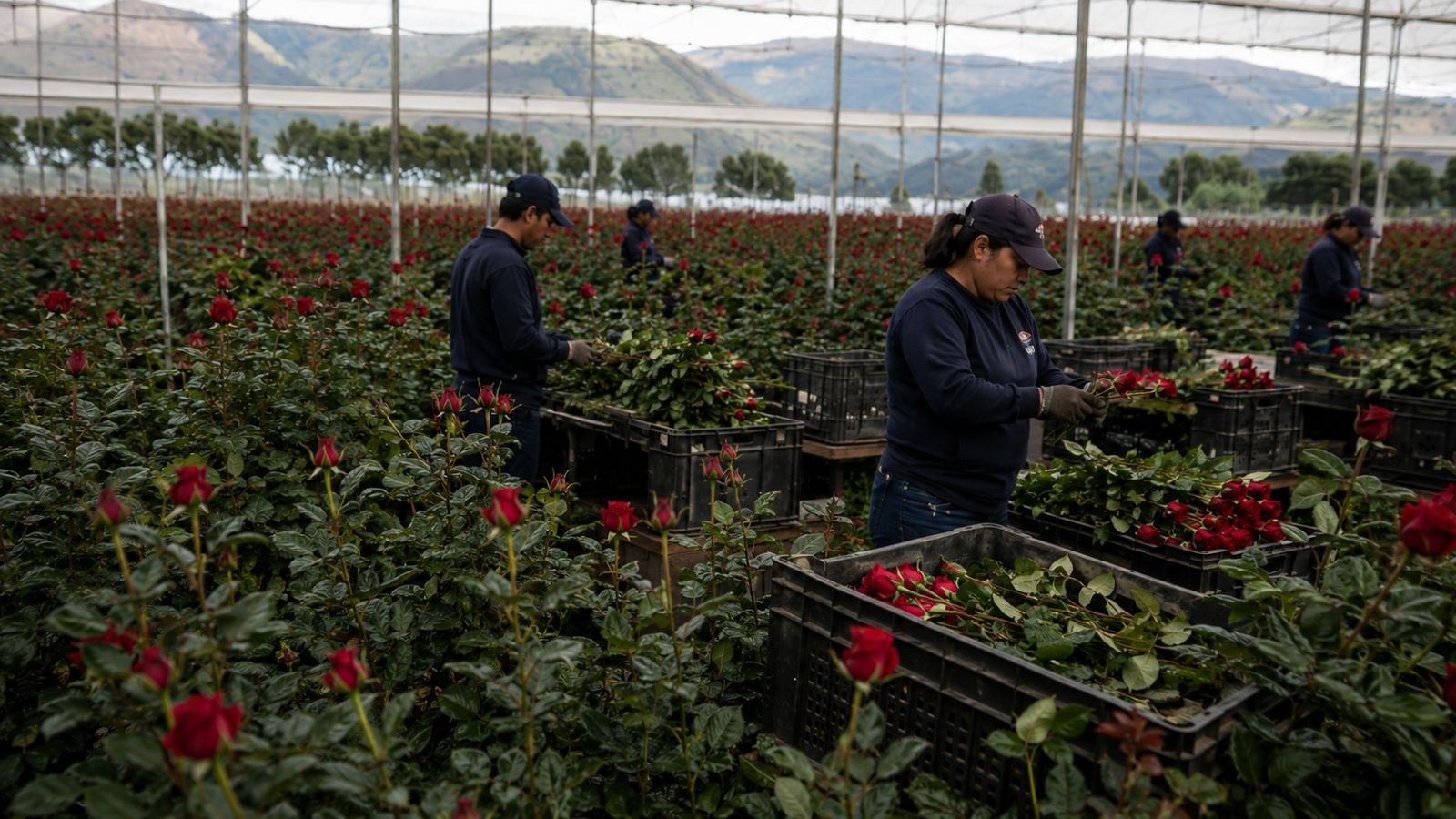
Ecuadorian roses are grown primarily in the high-altitude regions of the Andes, around Cayambe, Tabacundo, Quito, and in Cotopaxi Province. Farms in these areas operate close to the equator, benefiting from consistent daylight and a combination of intense sunlight and cool nights. For cut roses, this is a significant advantage: the plants develop more slowly, giving the stems time to gain length and strength while the buds develop their size and color.
This is why Ecuadorian roses hold a prominent position in the international wholesale flower trade. They are purchased by florists, luxury event planners, retailers, and businesses requiring regular flower programs. However, "Ecuadorian rose" does not refer to a single standardized product. Farms differ in their cultivars, growing altitude, packaging formats, production capacity, logistics, and transparency of information.
The list below is neither an official ranking nor a placement from first to tenth. Ecuador does not have a single publicly accessible registry that regularly compares all rose farms by current acreage, export volume, and productivity. Instead, this is an analytical selection of 10 notable and well-documented rose producers in Ecuador.
Why Ecuadorian Roses Are Valued on the Global Market
Large buds and long stems are not produced by genetics alone. The characteristics of a cut rose are influenced by the entire production cycle, including altitude, light intensity, differences between daytime and nighttime temperatures, plant nutrition, crop protection, harvest timing, and post-harvest handling.
High-altitude farms in the Andes often grow roses at elevations ranging from 2,800 to 3,300 meters. Under these conditions, growers can produce firm stems and well-defined bud forms, although the final result still depends on the individual cultivar and the farm's growing practices. It is not accurate to promise the same stem length or bud size for all roses grown in Ecuador. These specifications should be requested for each cultivar.
An uninterrupted cold chain during storage and transportation is equally important for the buyer. A rose may appear flawless in the greenhouse but lose part of its vase life because of delays after harvest, incorrect temperatures, or an excessively long logistics route. When comparing wholesale rose suppliers, buyers should therefore consider more than catalog images. The harvest date, shipping day, packaging specifications, and route to the final destination are also critical.
10 Rose Producers from Ecuador
This is not a ranking, but a selection of growers with different production scales, assortments, and areas of specialization.
RosaPrima
A fully controlled process covering cultivation, cutting, and packing.
Agrogana / Doña Natalia
A family-owned operation with several farms.
Agrocoex
A grower that publishes information on acreage and assortment.
Royal Flowers
A large producer with an established international supply network.
BellaRosa
An independent brand within The Elite Flower Group.
Qualisa
A specialized rose brand with a publicly available assortment.
Naranjo Roses
A producer of fresh and preserved roses.
Ecuagarden / Boutique Flowers
A family-owned farm supplying customers directly.
Tessa Corporation
A large-scale operation with an extensive rose assortment.
Valleverde Farms
A specialized rose-growing operation.
How the Selection Was Compiled
The selection is based on official farm websites, proprietary catalogs, production-related publications, and official materials from industry exhibitions. The evaluation considered specialization in roses, publicly reported scale, cultivar range, company history, export presence, technology, environmental practices, certification, and participation in the professional flower industry.
When a farm does not disclose its acreage, export volume, or certificate validity period, this does not mean that the operation is small or uncertified. It means only that the figure cannot be used responsibly for direct comparison. For the same reason, the farms are not ranked from first to tenth.
RosaPrima
RosaPrima grows roses in the Guachalá area near Cayambe. On its official website, the company emphasizes that its roses are grown, harvested, and packed within its own farm, without supplementing orders with flowers from third-party producers. This model is relevant to buyers who require consistent lots and a single point of responsibility for product quality.
The company traces its history to 1995 and reports 600 acres of land and more than 150 rose cultivars. Its public materials provide detailed information on cultivar trials, drip irrigation, composting, and integrated pest management. RosaPrima also reports Rainforest Alliance certification since 2013, FlorEcuador since 2013, SMETA since 2019, and BASC. The validity periods of individual certificates are not disclosed on the page, so buyers should request current documentation before purchasing. RosaPrima is included in this selection for its extensive rose collection, controlled production chain, and transparent information on sustainable growing practices.
Agrogana / Doña Natalia
Doña Natalia by Agrogana is a family-owned operation in the Cotopaxi Valley. The company states that it began operating in 1995, manages five farms, and has more than 60 hectares at an elevation of 3,300 meters. Its product range includes standard, garden, and spray roses, as well as seasonal and complementary flowers, making Agrogana a practical option for buyers assembling mixed flower orders.
The diversity of the assortment is as significant as the farm's altitude. Agrogana explicitly states that it exports worldwide and lists Fair Trade, Flor Ecuador, and BASC among its certifications. The public page does not provide document numbers or expiration dates, so it is accurate to refer to these as declared certifications rather than independently verified current certificates. Agrogana is included as a substantial family-owned producer with a clear focus on roses and a well-documented production location.
Agrocoex
Agrocoex operates in Cotopaxi, between Machachi and Tambó-Mulaló. It is one of the few Ecuadorian rose producers that publishes a comparable set of production figures on its own website: five farms, 75 hectares, more than 120 rose cultivars, and daily production exceeding 150,000 stems. The company also grows spray roses, ranunculus, anemones, carnations, and foliage.
This level of detail is useful to wholesale buyers because it indicates that the farm can supply not only individual cultivars but also part of a mixed flower order. Agrocoex dates its history to 1992 and displays the Florverde mark on its official website. A complete and current list of certifications, their validity periods, and the company's export markets is not publicly available. Even so, the published figures on acreage, production capacity, and assortment make Agrocoex one of the more transparent companies in this analytical selection.
Royal Flowers
Royal Flowers was founded in 1991 and operates offices in Quito and Miami. On its official website, the company reports more than 100 hectares of production, over 1,000 employees, and deliveries to more than 80 countries. Roses remain one of its principal specialties, and its wholesale model is oriented toward partners that require regular supply programs and established international logistics.
For a buyer, this does not automatically guarantee the availability of a specific cultivar or the quality of every shipment, but it does indicate an established operation. The company has extensive export experience, post-harvest infrastructure, and an international sales network. The official website does not disclose the precise altitude of its farms, the number of cultivars, revenue, or current certifications. Royal Flowers is included based on its published scale, history, and export geography, not on unverified estimates of turnover.
BellaRosa
BellaRosa is located in Tabacundo and continues to operate under its own brand, although it has been part of The Elite Flower Group since 2021. This distinction is important for buyers: the group and the individual farm are not the same entity, and order specifications should be confirmed with the relevant brand and production site. BellaRosa's official timeline shows growth to 60 hectares and 605 employees by 2020, followed by the establishment of a centralized post-harvest facility serving 72 hectares by 2025.
The farm reports receiving the Silver Award at the AIPH International Grower of the Year 2020 and displays Florverde and BASC marks on its website. Without registry numbers and expiration dates, these marks cannot be interpreted as confirmation that each certificate is currently valid. BellaRosa is notable for its established history, documented production growth, and integration into a major flower group. For professional floral purchasing, buyers should confirm the current catalog and availability of specific garden or tinted rose cultivars.
Qualisa
Qualisa is an Ecuadorian rose brand identified by its official website as part of The Elite Flower Group. Its catalog and company pages feature garden and classic roses, including cultivars with distinctive color characteristics. For buyers, this is an example of a producer where the selection process should begin not with the group name, but with the specific collection, stem specifications, and availability for the required production week.
The company publishes a separate Fairtrade catalog dated March 2026, and its website states that it joined the Fairtrade initiative in 2015. Primary public data on acreage, altitude, production volume, and certificate validity is not available. This prevents direct comparison with farms that publish hectares and production figures, but it does confirm Qualisa's active rose assortment and its position within an international flower group. The brand is included as a specialized rose supplier with a publicly accessible product range.
Naranjo Roses
Naranjo Roses grows roses in Cotopaxi and reports operating three farms. In a 2025 publication, the company stated that it offers more than 97 cultivars and also develops preserved roses under the Lulu Rose brand. This combination broadens the options available to event designers and decorators, as fresh roses and long-lasting preserved arrangements require different purchasing and logistics strategies.
Naranjo Roses' public materials place considerable emphasis on the Blooming Together initiative and on support for women and employees' families. The company has also published information about its participation in SAF Arizona 2025. This does not replace production or export revenue data, but it demonstrates an active presence in the professional flower industry. Claims found in earlier third-party summaries concerning more than 50 hectares, exports to 61 countries, and a specific list of certifications could not be confirmed through official sources and are therefore not used here.
Ecuagarden / Boutique Flowers
Ecuagarden, operating under the historic name Boutique Flowers, is located in Tabacundo. It is a family-owned farm that, according to its own information, has grown roses since 1985. The company publishes an unusually detailed set of production specifications for the industry: an elevation of 2,800 meters, 103 cultivars, and 3 million square feet of greenhouse space, equivalent to approximately 27.9 hectares.
Rather than relying on the general image of a "large farm," Ecuagarden emphasizes direct supply to importers, supermarkets, and florists. Its stated markets include the United States, Europe, Russia, and the Middle East. The company also identifies itself as a member of Expoflores and describes practices intended to protect soil, water, and employees. Certificate numbers and validity periods are not published. Within this selection, Ecuagarden represents a farm whose value is based not only on scale, but also on detailed product information, family continuity, and a direct working model with buyers.
Tessa Corporation
Tessa Corporation operates in Ecuador's Andean region and publishes one of the largest sets of production figures in this selection: operations beginning in 1997, 271 hectares of land dedicated to flower production, an elevation of 3,100 meters, more than 350 rose cultivars, and a workforce exceeding 3,000 people. The company also grows spray roses, alstroemeria, and other crops, and reports serving customers across five continents.
In January 2025, Tessa acquired the Ponte Tresa farms, and in 2026 the company announced that it had received Ecuador Carbono Cero distinctions for measuring and reducing its carbon impact. Automated irrigation and modern post-harvest infrastructure are described by the company itself. A 2024 reference to Rainforest Alliance certification describes the certification process as ongoing, so it should not be presented as an active certificate. Tessa is included for its published scale, extensive assortment, and documented investment in production infrastructure.
Valleverde Farms
Valleverde Farms specializes in roses grown in Cayambe. Its publicly available corporate profile reports 60 hectares in production, an elevation of 3,200 meters, and approximately 700 employees. The professional IFTF 2025 catalog confirms the company's participation in the exhibition and lists Valleverde Farms S.A.S. as an exhibitor from Ecuador.
This entry is intentionally described more cautiously than the others. During the research period, the farm's official website did not provide sufficiently detailed and accessible information on cultivars, founding year, markets, production volume, or certifications. Valleverde should therefore not be compared using unverified figures for cultivar count or exports. The farm is included because of its specialization in roses, documented acreage, high-altitude location, and participation in a professional trade exhibition. For commercial inquiries, it is particularly important to request an up-to-date catalog and supporting documents before agreeing on a purchasing program.
What to Consider When Choosing an Ecuadorian Rose Farm
Choosing a rose supplier in Ecuador should begin not with a general list of the "best farms," but with a technical specification for the intended order. A large farm may be better suited to stable volumes and a broad catalog, while a smaller specialized nursery may perform better with a rare cultivar, more precise grading, or direct communication.
Before placing an order, request:
- a current cultivar catalog with product codes and photographs from the specific farm;
- available stem lengths, harvest stage, and bud size for the selected cultivar;
- packaging specifications, including the number of stems per bunch and box, head protection, and labeling;
- the minimum order quantity, harvest days, shipping date, and estimated transit time;
- the required temperature range, departure airport, logistics route, and the party responsible for maintaining the cold chain;
- copies of current certificates showing the certificate number, certification scheme, and expiration date;
- the farm's capacity for regular supply and its experience serving the target market.
A catalog photograph is not a substitute for a technical specification. For a luxury event, buyers should request a sample or photographs of the actual lot. For ongoing purchasing programs, acceptable stem length, bud opening stage, stem count, and claims procedures should be agreed in advance. This turns a general request for "wholesale Ecuadorian roses" into a structured and verifiable order.
Conclusion
Ecuadorian rose farms operate under very different models, ranging from large groups with hundreds of cultivars and their own international infrastructure to family-owned farms focused on direct relationships with importers. The high-altitude conditions of the Andes provide a common production environment, but the result for the buyer depends on the specific cultivar, production week, packaging, and logistics.
The Ecuadorian rose market extends far beyond these ten farms. Suppliers should be selected according to the required stem length, volume, budget, destination market, and documented certification requirements rather than brand recognition alone. The Flora Market catalog includes most of the farms featured in this article, along with other producers of roses from Ecuador, providing a practical starting point for comparing available products and suppliers.
Frequently Asked Questions About Ecuadorian Rose Farms
Below are concise answers to the questions buyers and importers most often ask when evaluating Ecuadorian rose producers.
Why are Ecuadorian roses considered a premium product?
The quality of an Ecuadorian rose is influenced by the combination of high-altitude growing conditions, consistent daylight, intense sunlight, and cool nights. These conditions support the development of long, strong stems and well-defined buds, although the final characteristics still depend on the specific cultivar and the farm’s production methods.
Which regions of Ecuador are known for rose production?
This article focuses primarily on farms located around Cayambe, Tabacundo, and Quito, as well as in Cotopaxi Province. These high-altitude regions are among the most prominent areas for growing roses for export.
Should this selection be considered a ranking of the best rose farms?
No. This is not an official ranking and the farms are not listed by position. Public sources do not provide a single database that regularly compares all Ecuadorian rose farms by acreage, exports, and productivity using one consistent methodology.
Why is it difficult to compare rose farms directly?
Different farms disclose different levels of information. Some publish acreage, cultivar counts, and production figures, while others provide only assortment details, company history, and selected marketing materials. When a metric is not disclosed, it cannot be used responsibly for direct comparison.
What should buyers request before ordering roses from Ecuador?
Before placing an order, buyers should request a current cultivar catalog, available stem lengths, harvest stage, bud size, packaging format, minimum order quantity, shipping date, logistics route, temperature requirements, and copies of valid certificates showing the certificate number and expiration date.
Does a certification mark on a website confirm a farm’s current certification status?
Not always. If a farm displays a certification mark but does not publish the certificate number or validity period, the mark alone does not automatically confirm current status. Buyers should request the relevant documents separately before purchasing.
What affects the condition of roses during international shipping?
Buyers should consider not only the farm itself, but also post-harvest handling, the harvest date, shipping day, packaging, and an uninterrupted cold chain during storage and transport. Even a high-quality rose can lose part of its vase life when logistics standards are not maintained.
-
10 Leading Flower Farms in Colombia
Colombia’s flower industry is far more diverse than its reputation for roses alone suggests. The ...
-
Top 10 Ecuadorian Rose Farms
Ecuadorian rose farms differ significantly in scale, cultivar range, post-harvest systems, and ex...
-
Low-maintenance indoor plants for home, office, and gifts
Choosing an indoor plant is easier when the space, light, watering routine, and people caring for...

Categories
Playa blanca
 Ecuador
 Kenya
Kenya

Carnation Red
 Colombia
Pink Floyd
Ecuador